Hippocampal atrophy is a key imaging marker in Alzheimer’s disease (AD) and can also appear in conditions such as mesial temporal sclerosis, traumatic brain injury, depression, PTSD, and schizophrenia. Subtle early volume loss can be difficult to detect visually on MRI, which is why quantitative hippocampal volumetry has growing clinical value.
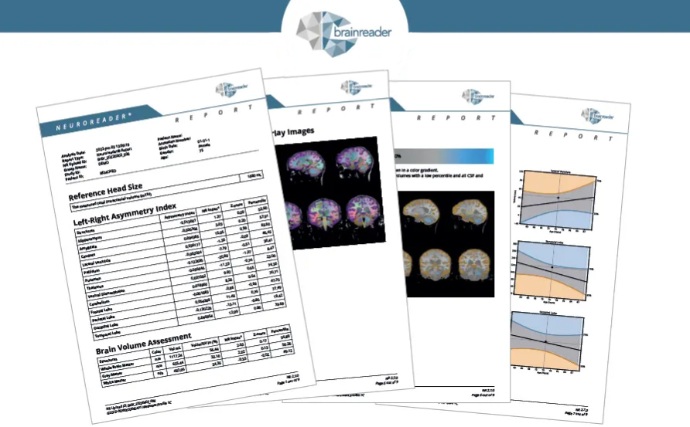
This open-access study in the Journal of Alzheimer’s Disease (2016) validates Neuroreader®, a US FDA-cleared software program for automated assessment of hippocampal volume on clinical brain MRI.
Study goal
To validate automated hippocampal segmentation and volumetry using Neuroreader® against gold-standard manual hippocampal tracing.
How the validation was done
Researchers analyzed 99 MRI scans drawn from the Alzheimer’s Disease Neuroimaging Initiative (ADNI), including scans from both 1.5T and 3.0T MRI systems.
Accuracy was measured using the Dice Similarity Coefficient (DSC), a standard metric of spatial overlap between two segmentations:
- 0 = no overlap
- 1 = perfect agreement
Results
High agreement with expert manual segmentation
Across both hippocampi, Neuroreader® achieved:
- Mean DSC: 0.87
- Right hippocampus range: 0.78–0.91
- Left hippocampus range: 0.76–0.91
Consistent accuracy at 1.5T and 3T
Agreement with manual segmentation was essentially equivalent across MRI field strengths:
- 1.5T: DSC = 0.879
- 3.0T: DSC = 0.872
Why it matters clinically
This validation supports Neuroreader® as a practical tool for quantifying hippocampal volume, a biomarker frequently abnormal in Alzheimer’s disease and other neurologic disorders. Automated hippocampal volumetry can help clinicians:
- Detect subtle hippocampal volume loss earlier than visual assessment alone
- Add objective, quantitative support to dementia workups
- Track hippocampal change over time for longitudinal assessment
Key takeaway
Neuroreader® provides automated hippocampal volumetry with high agreement to manual tracings and consistent performance at both 1.5T and 3T, supporting its use in real-world clinical MRI environments.
Read the Full Article