Case Studies
Neuroreader® has been independently validated in
peer-reviewed research and clinical practice as a reliable,
FDA-cleared tool for fast and accurate brain volumetric analysis.
Dr. Cyrus A. Raji demonstrates how to interpret Neuroreader®
Reports in the following clinical case studies.
Neuroreader Case Study 1: Alzheimer Dementia
This educational case study reviews the MRI findings of a 78-year-old woman with progressive memory loss who underwent automated brain volumetric analysis using Neuroreader®. Using a 3D T1-weighted MRI, Neuroreader® measures the volume of multiple brain structures and compares them with an age- and sex-matched normative database, providing objective data to support the evaluation of neurodegenerative disease.
Neuroreader Case Study 2: Longitudinal Imaging of Alzheimer Disease
This educational case study follows a 69-year-old woman with memory loss and depression who underwent four MRI examinations over seven years (ages 62, 64, 66, and 69). Using Neuroreader® automated brain volumetric analysis, progressive changes in brain volume were objectively measured and tracked over time.
Neuroreader Case study 3: Traumatic Brain Injury
This educational case study reviews the MRI findings of a 62-year-old woman with persistent post-concussive symptoms following a motor vehicle collision. Her symptoms included headaches, memory loss, difficulty with attention, and light sensitivity. Automated brain volumetric analysis using Neuroreader® demonstrated a pattern of brain volume changes that differs from the classic pattern seen in Alzheimer's disease.
Neuroreader Case Study 4: Frontal Temporal Dementia
This educational case study demonstrates how automated MRI brain volumetric analysis can help differentiate frontotemporal dementia (FTD) from Alzheimer's disease (AD) by objectively measuring regional brain atrophy.
The patient is a 66-year-old man with gradually progressive personality changes and memory loss. Because these symptoms can overlap among neurodegenerative disorders, quantitative MRI volumetry provides valuable information by identifying characteristic patterns of brain volume loss.
Neuroreader Patient Case 1:
Alzheimer's Dementia
Neuroreader Patient Case 2:
Traumatic Brain Injury
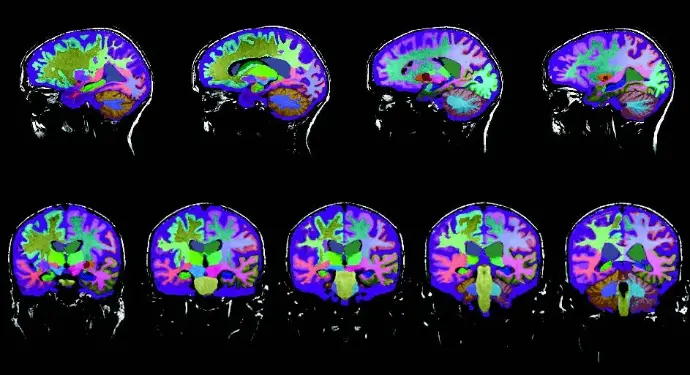
Applying Quantitative Neuroimaging With Neuroreader® in Geriatric Psychiatry
By Cyrus A. Raji, MD, PhD, and David A. Merrill, MD, PhD
Published in Today’s Geriatric Medicine, Vol. 9, No. 5, p.16.
Alzheimer’s disease (AD) is the leading cause of dementia, currently affecting over 5 million Americans, with cases expected to rise dramatically as the population ages. While AD is incurable, other conditions such as late-life depression, vascular dementia, and traumatic brain injury can mimic its symptoms, often leading to misdiagnosis and delayed treatment.
About Dr. Cyrus A. Raji
Cyrus A. Raji, MD, PhD is a diagnostic neuroradiologist at Barnes Hospital, Washington University in St. Louis, Missouri, with internationally recognized expertise in neuroimaging. His research and clinical work focus on applying multi-modal structural and functional imaging to neuropsychiatric disorders and head trauma.
Credentials & Achievements
- Diagnostic Radiology Residency, UCLA Medical Center (4 years)
- 2016 Radiological Society of North America (RSNA) Roentgen Research Award for outstanding contributions in Radiologic Research
- Fellowship in Traumatic Brain Injury (TBI), UCSF San Francisco (2 years)
- 2017 American Society of Neuroradiology Boeger Award Grant for Alzheimer’s Imaging research
- Published 30+ peer-reviewed papers in leading journals including Neurology, Human Brain Mapping, American Journal of Preventive Medicine, and American Journal of Neuroradiology
Get in Touch with Brainreader
Have a question about Neuroreader®, brain volumetric imaging, or workflow integration?
Our team is here to support clinicians, imaging centers, researchers, and partners exploring advanced brain health solutions.