Authors
Cyrus A. Raji, MD, PhD
Department of Neurology
Washington University, St. Louis
Somayeh Meysami, MD
Department of Neurology
David Geffen School of Medicine at UCLA
Los Angeles, CA
Mario F. Mendez, MD, PhD
Department of Neurology
David Geffen School of Medicine at UCLA
Los Angeles, CA
Source: Practical Neurology
Website: practicalneurology.com
Introduction
Neurocognitive disorders are prevalent clinical problems. Among the most common are Alzheimer disease (AD) dementia and frontotemporal dementia (FTD), respectively the first and second most common neurodegenerative causes of dementia worldwide. Collectively, these conditions affect almost 6 million persons in the US alone.¹,² Traumatic brain injury (TBI) is also a common problem affecting 2.5 million persons annually.³ TBI increases the risk for later dementia and chronic traumatic encephalopathy (CTE).⁴ Because all of these disorders can present with cognitive impairment, the ability to apply improved diagnostic tools is crucial for patient care.
The current clinical standard of care in neuroradiology involves visual inspection of brain MRI. When attempting to detect the earliest volume loss related to brain atrophy, however, visual inspection alone lacks sensitivity compared with automated methods.⁵ The purpose of this review is to present a brief outline of available quantitative analytic methods that can be applied to brain MRI to detect volume loss from atrophy in AD dementia; behavioral variant FTD (bvFTD), which is the most common form of FTD; and TBI.
Although there are other imaging methods for the evaluation of neurocognitive disorders, there are several reasons to emphasize the volumetric quantification of brain MRI.
- First, patient access is maximized compared with neuronuclear methods such as positron emission tomography (PET).
- Second, the cost of an MRI is 60% lower than glucose metabolic imaging with fluorodeoxyglucose PET (FDG-PET) and 80% reduced in cost compared to an amyloid PET scan.⁶
- Third, quantification of hippocampal volume loss on MRI is recognized as a key metric of neurodegeneration in the amyloid, tau, and neurodegeneration (ATN) framework.⁷
It is also possible that developing blood-based biomarkers for amyloid and tau may obviate the clinical use of amyloid or tau PET imaging in the future. (See Blood Tests for Alzheimer Disease in this issue.)⁸
Findings in Alzheimer's Disease (AD)
AD dementia is a progressive disorder leading to cognitive decline in multiple domains including episodic memory, language, and visuospatial skills.⁹ Volumetric quantification of brain MRI in AD dementia most commonly includes the temporal and parietal lobes as well as the hippocampus.¹⁰
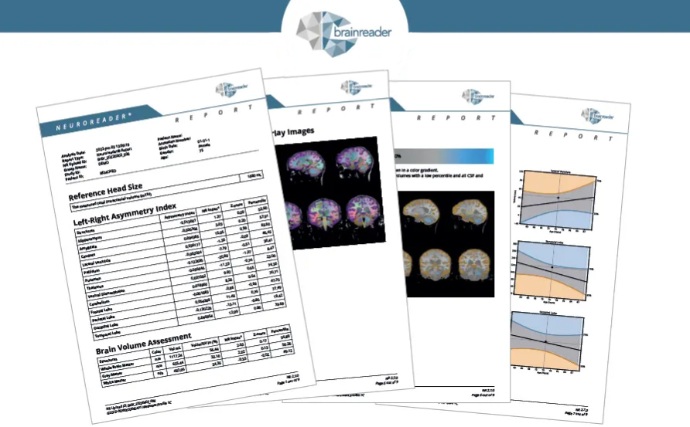
The magnitude of this change varies with the type of FDA-cleared software used for analysis—a 5th percentile and lower cutoff to distinguish normal from abnormal with one software package (NeuroQuant) and a 25th percentile or lower for the other available software package (NeuroReader).¹¹,¹²
Whereas NeuroQuant relies on multiple normal databases drawn from a combination of research databases and clinical samples with an age range of 3 to 100 years,¹³ the NeuroReader database is drawn currently from the Alzheimer's Disease Neuroimaging Initiative (ADNI) with an age range of 60 to 90 years.
Ventricular enlargement from volume loss is also a feature of AD and typically manifests as volumes greater than the 75th percentile of normal. A separate FDA-cleared software program, Icometrix, has recently shown high diagnostic performance when compared with the research program FreeSurfer.¹³ Another FDA-cleared program (Quantib) uses normative data from the population-based Rotterdam Study.¹⁴
Hippocampal volume loss alone is not entirely specific for AD and can also be observed in disorders including mesial temporal sclerosis¹⁵ and hippocampal sclerosis.¹⁶ Quantification of specific hippocampal subfields may bridge diagnostic gaps but is not currently available in FDA-cleared software.¹⁷
Findings in Behavioral Variant Frontotemporal Dementia (bvFTD)
The misdiagnosis of bvFTD is common, with up to 60% of persons diagnosed with bvFTD by community specialists having other conditions upon further evaluation by specialists.¹⁸
Volumetric quantification findings are distributed throughout the frontal and temporal lobes. A meta-analysis demonstrates affected regions including:
- Anterior medial frontal cortex
- Anterior cingulate gyrus
- Thalamus
- Anterior insula
Progressive posterior frontal lobe atrophy occurs as disease advances.¹⁹,²⁰
Findings in Traumatic Brain Injury (TBI)
Using NeuroQuant software, atrophy was found in 50% of cases of mostly mild TBI, whereas visual radiologic interpretation detected atrophy in only 10%.²¹
Longitudinal studies demonstrated:
- Abnormal asymmetry in 83.3% of cases
- Progressive atrophy in 70% of cases
Visual interpretation detected none of these findings.²²
NeuroReader measures additional brainstem structures implicated in TBI and chronic traumatic encephalopathy.²³
Longitudinal case reports demonstrated progressive midbrain and ventral diencephalon atrophy in a former football player.²⁴ In a larger cohort, the ventral diencephalon was the most atrophic region, whereas the hippocampus was the least affected.²⁵
Conclusions
Volumetric MR quantification improves detection of brain atrophy across neurodegenerative disease and traumatic brain injury and is readily available for clinical use.
Proper ordering of a 3D T1 protocol and close collaboration between neurologists and neuroradiologists are essential for meaningful interpretation and patient care integration.
References
- 2020 Alzheimer's disease facts and figures. Alzheimers Dement. 2020. doi:10.1002/alz.12068
- Onyike CU, Diehl-Schmid J. The epidemiology of frontotemporal dementia. Int Rev Psychiatry. 2013.
- Centers for Disease Control and Prevention. Traumatic Brain Injury and Concussion. Published March 29, 2019.
- Mendez MF, Paholpak P, Lin A, Zhang JY, Teng E. Prevalence of traumatic brain injury in early versus late-onset Alzheimer's disease. J Alzheimers Dis. 2015.
- Bigler ED. Traumatic brain injury, neuroimaging, and neurodegeneration. Front Hum Neurosci. 2013.
- Desikan RS, Rafii MS, Brewer JB, Hess CP. An expanded role for neuroimaging in the evaluation of memory impairment. AJNR. 2013.
- Jack CR Jr, Bennett DA, Blennow K, et al. NIA-AA Research Framework. Alzheimers Dement. 2018.
- Palmqvist S, Janelidze S, Quiroz YT, et al. Discriminative accuracy of plasma phospho-tau217. JAMA. 2020.
- Mendez MF. The accurate diagnosis of early-onset dementia. Int J Psychiatry Med. 2006.
- Raji CA, Lopez OL, Kuller LH, Carmichael OT, Becker JT. Age, Alzheimer's disease, and brain structure. Neurology. 2009.
- Brewer JB. Fully automated volumetric MRI with normative ranges. Behav Neurol. 2009.
- Ahdidan J, Raji CA, DeYoe EA, et al. Quantitative neuroimaging software for clinical assessment of hippocampal volumes. J Alzheimers Dis. 2016.
- Struyfs H, Sima DM, Wittens M, et al. Automated MRI volumetry as a diagnostic tool for Alzheimer's disease. Neuroimage Clin. 2020.
- Hofman A, Brusselle GG, Darwish Murad S, et al. The Rotterdam Study. Eur J Epidemiol. 2015.
- Mettenburg JM, Branstetter BF, Wiley CA, Lee P, Richardson RM. Improved detection of subtle mesial temporal sclerosis. AJNR. 2019.
- Zarow C, Wang L, Chui HC, Weiner MW, Csernansky JG. MRI shows more severe hippocampal atrophy in hippocampal sclerosis. Int J Alzheimers Dis. 2011.
- Manjón JV, Coupé P. volBrain: an online MRI brain volumetry system. Front Neuroinform. 2016.
- Shinagawa S, Catindig JA, Block NR, Miller BL, Rankin KP. False-positive diagnosis of bvFTD among community clinicians. Dement Geriatr Cogn Disord. 2016.
- McCarthy J, Collins DL, Ducharme S. Morphometric MRI as a diagnostic biomarker of frontotemporal dementia. Neuroimage Clin. 2018.
- Rohrer JD. Structural brain imaging in frontotemporal dementia. Biochim Biophys Acta. 2012.
- Ross DE, Ochs AL, Seabaugh JM, Shrader CR. Man versus machine: NeuroQuant vs radiologist interpretation in TBI. J Neuropsychiatry Clin Neurosci. 2013.
- Ross DE, Ochs AL, DeSmit ME, Seabaugh JM, Havranek MD. Man versus machine Part 2. J Neuropsychiatry Clin Neurosci. 2015.
- Barrio JR, Small GW, Wong KP, et al. In vivo characterization of chronic traumatic encephalopathy. Proc Natl Acad Sci USA. 2015.
- Raji CA, Merrill DA, Barrio JR, Omalu B, Small GW. Progressive focal gray matter volume loss in a former football player. Am J Geriatr Psychiatry. 2016.
- Meysami S, Raji CA, Merrill DA, Porter VR, Mendez MF. MRI volumetric quantification in persons with traumatic brain injury and cognitive impairment. J Alzheimers Dis. 2019.