
As hospitals look to balance clinical excellence with financial sustainability, imaging departments are under increasing pressure to deliver accurate results quickly and cost-effectively. Traditional brain MRI interpretation can be labor-intensive, requiring hours of manual segmentation and review.
With modern tools, however, the cost of volumetric MRI is shifting from high overhead toward a more predictable, scalable model. Automated solutions with pay-per-use volumetric analysis can provide both time savings and measurable return on investment.
The Cost of Traditional Volumetric MRI
Manual or research-based volumetric analysis often requires:
- 30 minutes to 2 hours of radiologist or specialist time per case
- Dedicated workstations or added software licenses
- Limited scalability for routine clinical use
For hospital administrators, these factors translate into higher labor costs, longer turnaround times, and lost opportunities to serve more patients efficiently.
How Automated Volumetric Imaging Reduces Costs
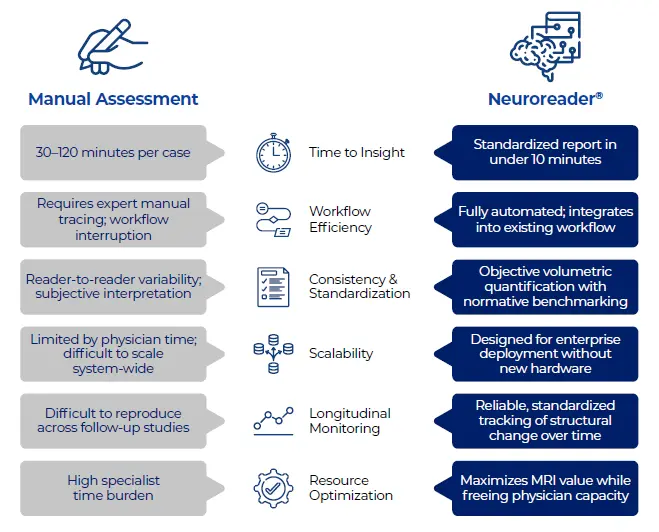
Automated solutions now generate quantitative MRI reports in under 10 minutes, directly from existing scan data. The benefits include:
- Time savings: Radiologists spend less time measuring structures, allowing for faster reporting.
- Standardization: Objective, reproducible data minimizes variability and reduces the need for secondary reviews.
- Workflow efficiency: Reports are delivered seamlessly into existing PACS systems, eliminating duplicate steps.
The Pay-Per-Use Advantage
One of the most important shifts for CFOs is the pay-per-use volumetric analysis model. Instead of large upfront costs for hardware and licenses, hospitals only pay when they generate a report.
This model offers:
- Zero setup costs: No new hardware required.
- Scalability: Expand usage as demand grows, without financial risk.
- Budget predictability: Costs align directly with clinical volume.
ROI of Automated MRI Reports

Hospitals adopting MRI volumetrics ROI models report benefits such as:
- Improved throughput: faster reads allow for more patients per day.
- Enhanced reputation: advanced imaging capabilities attract referrals.
- Reduced risk of misdiagnosis and downstream costs.
- Revenue growth: volumetric analysis can be billed as an advanced imaging service.
The Takeaway
For administrators and finance leaders, the economics of volumetric imaging are clear. Automated MRI report cost savings reduce labor expenses, shorten turnaround times, and improve clinical throughput. With pay-per-use volumetric analysis, hospitals can access advanced imaging without the burden of upfront investment, and scale as needed.