
Why Monitoring Matters More Than Ever
Alzheimer’s disease is not a static condition, it is a progressive neurodegenerative disorder characterized by gradual loss of brain tissue over time.
For clinicians, this presents a critical challenge: it’s not enough to diagnose Alzheimer’s. You must also monitor how it evolves.
As new therapies and care strategies emerge, the ability to track disease progression objectively is becoming just as important as early detection.
This is where volumetric MRI, and specifically Neuroreader®, plays a vital role.
The Limits of Traditional Monitoring
Historically, Alzheimer’s monitoring has relied on a combination of clinical assessments (cognitive tests, patient history), visual MRI interpretation, and functional imaging (in some cases). While valuable, these approaches have limitations.
Clinical Assessments Can Lag Behind Structural Changes
Cognitive decline often appears after significant brain changes have already occurred.
Visual MRI Lacks Precision
Radiologists may describe changes as “Mild progression” or “Appears stable”, but these are qualitative assessments, not measurements.
Inconsistent Longitudinal Comparisons
Comparing scans over time visually introduces variability with differences in interpretation, subtle changes overlooked, and difficulty quantifying progression.
The Need for Objective, Longitudinal Data
Effective Alzheimer’s management requires consistency across timepoints, precision in detecting small changes, and objectivity in assessing progression. Volumetric MRI addresses all three by turning imaging into quantifiable data.
How Volumetric MRI Enables Better Monitoring
Volumetric MRI allows clinicians to track whole-brain volume changes, regional atrophy (e.g., hippocampus, temporal lobes), and structural patterns associated with disease progression. Instead of estimating change, clinicians can measure it directly.
Measuring What Matters
- Whole -brain volume changes
- Regional atrophy (e.g., hippocampus)
- Structural patterns
Detecting Subtle Progression
- Early progression
- Gradual decline across regions
- Changes that may correlate with future symptoms
Standardized Comparisons
- Percentile rankings
- Z-scores
- Demographic-adjusted benchmarks
The Role of Neuroreader® in Longitudinal Monitoring
Designed for Clinical Use
Neuroreader® brings volumetric MRI into routine practice by providing:
- Automated segmentation of 83 brain regions
- Normative comparisons adjusted for age, sex, and head size
- Rapid processing in under 10 minutes
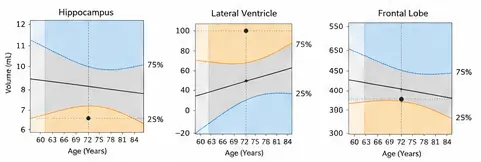
Longitudinal Tracking Capabilities
One of the most powerful features of Neuroreader® is its ability to track change over time. Clinicians can visualize:
- Percentile shifts across repeated scans
- Whole-brain volume decline
- Regional progression patterns
These insights are presented in clear, structured reports, making interpretation straightforward.
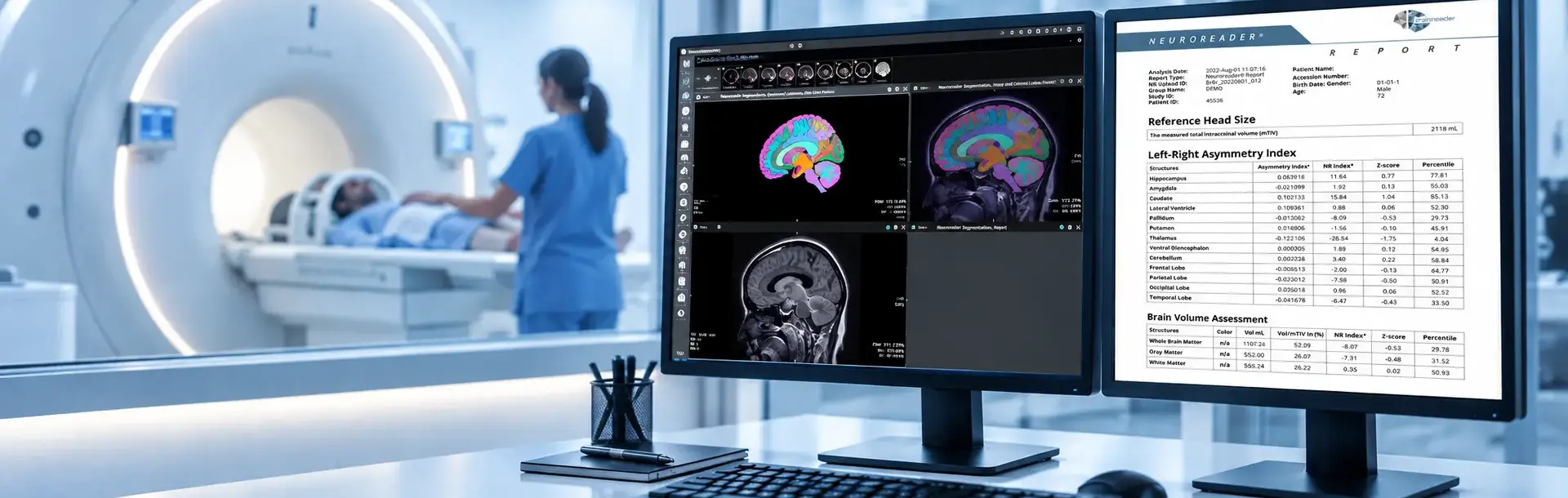
From Snapshots to Trends
Traditional MRI provides a single snapshot in time.
Neuroreader® transforms this into:
A timeline of disease progression
This shift is critical for understanding:
- How quickly the disease is advancing
- Whether progression is accelerating or stabilizing
- How different regions are affected
Clinical Applications in Alzheimer’s Monitoring

Why This Matters in Today’s Treatment Landscape
With the development of new Alzheimer’s treatments, the focus is shifting toward:
- Earlier intervention
- Slowing disease progression
- Monitoring outcomes over time
These therapies require:
- Reliable biomarkers
- Objective tracking tools
- Consistent longitudinal data
Volumetric MRI is increasingly being used as a surrogate marker for disease progression.
In both research and clinical settings, volumetric data helps:
- Evaluate treatment effectiveness
- Standardize outcomes
- Improve decision-making
Advantages of Using
Neuroreader® for Monitoring
Speed and Efficiency
- Results in under 10 minutes
- No manual segmentation required
Consistency
- Standardized measurements across timepoints
- Reduced variability between readers
Clinical Clarity
- Easy-to-interpret reports
- Clear visualization of progression
Scalability
- Can be applied across large patient populations
- Fits within routine imaging workflows
Integrating Monitoring into Routine Care
Minimal Workflow Disruption
Neuroreader® is designed to integrate seamlessly with existing systems:
- PACS integration
- Web-based access
- No additional hardware required
Standard Imaging Protocols
Volumetric analysis uses:
- Routine 3D T1 MRI sequences
- No contrast required
This makes adoption straightforward.
Supporting Multidisciplinary Care
Quantitative data can be shared across:
- Radiologists
- Neurologists
- Referring physicians
This improves coordination and consistency in patient care.
The Future of Alzheimer’s Monitoring
From Reactive to Proactive Care
Traditionally, care has been reactive, responding to symptoms as they appear.
With volumetric MRI, clinicians can:
- Identify changes earlier
- Monitor progression more precisely
- Adjust care proactively
A More Data-Driven Approach
The future of Alzheimer’s care will rely on:
- Objective biomarkers
- Quantitative imaging
- Longitudinal data
Neuroreader® is part of this shift toward precision medicine in neurology.
Conclusion: Turning Data into Better Care
Monitoring Alzheimer’s disease requires more than observation, it requires measurement, consistency, and clarity.
Volumetric MRI provides the foundation for this approach by transforming MRI data into objective, trackable insights.
With Neuroreader®, clinicians gain:
- A clearer understanding of disease progression
- More confidence in treatment decisions
- Better tools to support patients over time
In a disease where timing and precision matter, these advantages can make a meaningful difference.