FOR VETERANS & THEIR FAMILIES
Have You Noticed Changes
in Your Memory or Thinking?
Changes in memory, concentration, or thinking can happen for
many reasons. If you or someone close to you has noticed a change,
it may be worth discussing with your VA healthcare provider.
Your provider can help determine whether further neurological
evaluation, and potentially a brain MRI, may be appropriate for you.
What Conditions Can Neuroreader Help With? How Do I Request Neuroreader?
FOR VETERANS & THEIR FAMILIES
Have You Noticed Changes
in Your Memory or Thinking?
Changes in memory, concentration, or thinking can happen for
many reasons. If you or someone close to you has noticed a change,
it may be worth discussing with your VA healthcare provider.
Your provider can help determine whether further neurological
evaluation, and potentially a brain MRI, may be appropriate for you.

HAVE YOU NOTICED A CHANGE?
Your Brain Health Is Worth a Conversation.
Sometimes changes are first noticed by you. Other times, a spouse, family member, or friend may notice them first.
Consider talking with your healthcare provider if you have questions or concerns such as:
- Are familiar tasks taking more effort or becoming more difficult?
- Are you having more difficulty finding the right words?
- Have changes in memory, concentration, or thinking become more noticeable over time?
- Has someone close to you noticed changes in your memory or thinking?
These experiences can have many possible causes. They do not, by themselves, tell you whether you have a neurological condition or whether you need an MRI.
The first step is a conversation with your healthcare provider.
UNDERSTANDING BRAIN MRI
A Brain MRI Provides Images.
Quantitative Analysis Adds Measurements.
A traditional brain MRI provides detailed images that trained physicians review as part of a neurological evaluation.
Quantitative brain volumetric analysis can provide another layer of information by measuring the volume of specific structures within the brain.
These objective measurements can be reviewed alongside your MRI images, symptoms, medical history, neurological examination, and other clinical information.
Think of it this way:
Traditional MRI
Shows brain anatomy
Provides detailed images for your healthcare team to review.
Quantitative Brain MRI
Adds objective measurements
Measures specific brain structures and provides numerical information that can supplement physician interpretation.
Your Healthcare Provider
Puts the information in context
Your physician determines what the imaging and measurements mean in the context of your overall health.


Longitudinal Information
When compatible serial MRI examinations are available, quantitative measurements from those examinations may provide additional information for physician review.

83 Brain Volumes
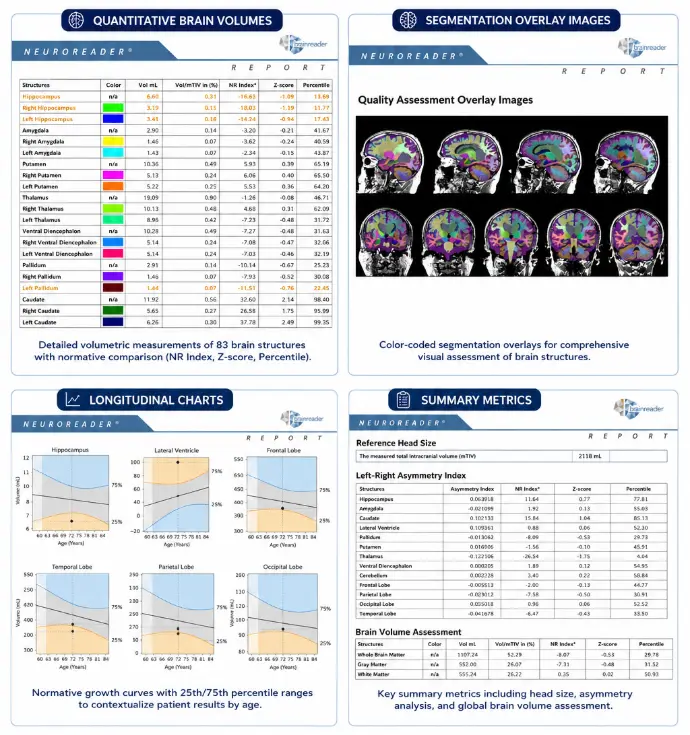
Neuroreader® provides objective measurements across 83 anatomical brain volumes.

Visual Information
The Neuroreader® report includes segmented images, measurements, charts, and other quantitative information to support physician review.

Normative Comparisons
Brain-volume measurements can be statistically compared with a reference population while accounting for factors such as age, sex, and head size.
MEET NEUROREADER®
Your Brain Is More Than an Image. It Can Be Measured.
Neuroreader® is FDA-cleared medical image-processing software designed to automatically label, visualize, and measure brain structures from compatible MRI images.
A Neuroreader® analysis provides your healthcare team with additional quantitative information to review as part of the complete clinical picture.
ASKING FOR A NEUROREADER SCAN
From Conversation to Quantitative Information
Neuroreader® is not something you schedule directly, it is prescribed by your physician.
1. Talk to Your Doctor
Ask your neurologist, primary care physician, or specialist:
"Can my MRI include a Neuroreader® volumetric analysis?"
2. Ask About a 3D Brain MRI
Your doctor may need to specify a 3D MRI sequence (such as MPRAGE or BRAVO) to enable Neuroreader® analysis.
3. Choose the Right Imaging Center
Some hospitals and imaging centers already offer Neuroreader®. If unsure, ask your provider or imaging facility.
Download a Patient-Friendly Overview
Clinical Applications of Automated Brain Volumetrics
Memory Loss & Brain Health
If you or a loved one are experiencing memory problems or changes in thinking, getting clear answers early is important.
Neuroreader® helps doctors better understand what’s happening in the brain by:
- Measuring key areas like the hippocampus (important for memory)
- Looking at overall brain volume and signs of shrinkage
- Comparing your brain to what’s typical for someone your age and background
This added insight can help your doctor identify early signs of conditions like Alzheimer’s or other forms of dementia, even before symptoms become more severe.
Head Injuries (TBI)
After a concussion or traumatic brain injury, symptoms don’t always match what can be seen on a standard MRI.
Neuroreader® provides a deeper level of analysis by:
- Measuring brain structures in detail
- Comparing the left and right sides of the brain
- Highlighting subtle changes that may otherwise go unnoticed
This can help your care team better understand the impact of an injury and guide next steps in care.
Tracking Changes Over Time
For ongoing conditions, it’s important to know whether things are staying the same, improving, or changing.
With Neuroreader®, doctors can:
- Track how brain measurements change over time
- See small shifts that may not be visible on standard scans
- Monitor how conditions are progressing or responding to treatment
This helps provide a clearer picture of your brain health over time, supporting more informed care decisions.
START THE CONVERSION
Questions You Can Ask Your VA Healthcare Provider
You don't need to know which test you need before talking with your provider. Start by explaining what you've noticed.
“Could the changes I've noticed warrant further neurological evaluation?”
“Would a brain MRI be appropriate based on my symptoms and medical history?”
“If a brain MRI is ordered, could quantitative brain volumetric analysis provide additional information?”
“Would objective brain-volume measurements be useful for my healthcare team?”
“If I've had previous brain imaging, could measurements over time provide useful additional information?”
Your healthcare provider can determine which evaluations or tests, if any, are appropriate for you.

ACCESS THROUGH VA
Neuroreader® Is Available to VA Healthcare Facilities
Brainreader has partnered with Lovell Government Services to support access to Neuroreader® across federal healthcare.Neuroreader® is available for procurement by eligible Federal healthcare facilities through Lovell Government Services.
What does that mean for Veterans?
You don't need to understand federal contracting or procurement to start the conversation.
Simply ask your VA healthcare provider whether quantitative brain MRI may be appropriate for your individual situation and whether Neuroreader® is an available option.

Lovell Government Services was founded in 2013 by retired U.S. Marine Corps Major Chris Lovell. Lovell helps companies bring advanced products to the Federal Government through certification, marketing, and contracting expertise, continuing its mission of serving America’s Warfighters.
Neuroreader is available on the GSA Advantage and FSS ordering systems through Lovell.
Frequently Asked Questions
Yes. Neuroreader® does not change your MRI experience.
- No additional scanning time required (beyond standard MRI protocols)
- No injections or contrast required for analysis
- No radiation exposure
It simply analyzes the MRI images after your scan is completed.
Neuroreader® works with a standard brain MRI, but your doctor may request a specific 3D imaging sequence to ensure the best results.
No.
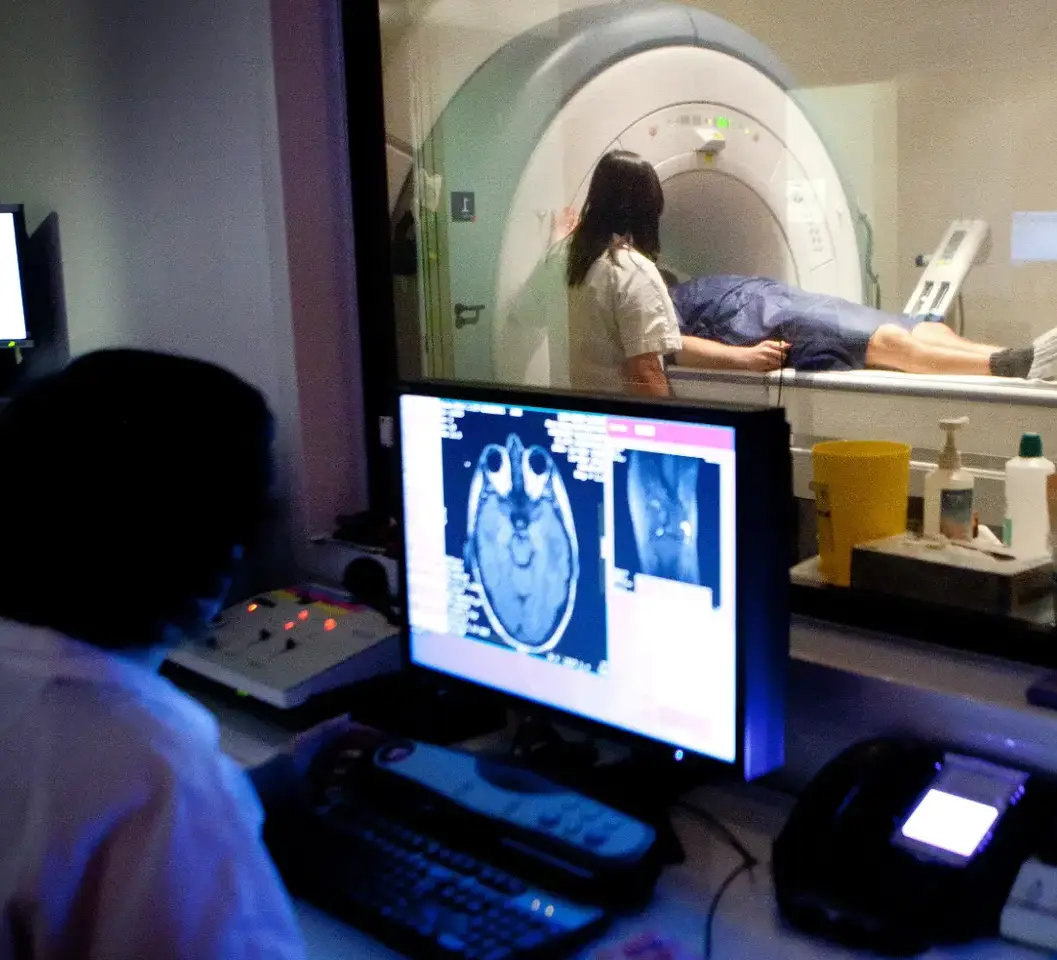
Your MRI will feel the same as any routine brain scan:
- No additional procedures
- No radiation
- No extra discomfort
Neuroreader® analyzes the images after your scan is complete.
Neuroreader® can generate a report in less than 10 minutes after your MRI is completed.
Your doctor will review the results and share them with you.
Neuroreader® is often used to support evaluation and monitoring of:
- Memory loss and dementia (including Alzheimer’s disease)
- Cognitive decline
- Traumatic brain injury (TBI)
-
Other neurological conditions
It can help doctors identify subtle changes in brain structure earlier than visual review alone, which may support earlier evaluation and care planning.
No.
Neuroreader® is a clinical support tool that provides additional data. Your doctor uses this information along with other tests and evaluations to make a diagnosis.
You can ask your doctor: “Can my MRI include Neuroreader® analysis?” .
Your physician will determine if it’s appropriate and include it when ordering your scan.
Availability may vary by hospital or imaging center. If your provider doesn’t offer it, you can ask about locations that do.
Coverage can vary depending on your provider and location. It’s best to:
- Ask your doctor or imaging center
- Contact your insurance provider directly
A standard MRI shows images of the brain.
Neuroreader® adds measurable data and comparisons, giving doctors a clearer, more objective understanding of what those images mean.
Neuroreader® is intended for automatic labeling, visualization, and volumetric quantification of segmentable brain structures from a set of MR images. Neuroreader® is an assessment tool and is not intended to replace evaluation by a qualified physician or trained practitioner. References to symptoms, head injury, or neurological conditions are provided for educational purposes and do not represent disease-specific FDA indications or a recommendation that any individual undergo MRI or Neuroreader® analysis.